I spent the first days of Advent in warm and sunny San Antonio, to meet and strategize with my fellow Jurisdiction Guides about the UMW Climate Justice goals for 2019.
This year we brought together several community organizations for a UMW event in Rio Texas Conference. We introduced our Just Energy 4 All campaign, which focuses our advocacy and action around decarbonization of the transportation and energy sectors. We are doing corporate engagement with Ford and Chevron, advocating for stronger environmental standards at the EPA, and educating our members on our 13 Steps to Sustainability. We do these things together--big policy and systemic change in addition to small personal change--because there is no silver bullet to solve the climate crisis. We need all of it.
We heard about the dangers of oil and gas industry from many perspectives. We heard from Sister Elizabeth Riebschlaeger, who has concerns about oil and gas workers and the lies they've been told about the health impacts of their work. She understands that the poor, rural residents of Karnes County, TX have been taken advantage of, promised tax revenue and jobs in return for leases to their land. Instead, drinking water wells have been poisoned, habitats destroyed, and the promised profits never materialized. Being good, neighborly folks, though, the residents don't want to make any trouble. So they allow the fracking to continue. But as Sister Elizabeth says, we're all children of God and deserve to live with clean land, air, and water.
We heard from Adelita Gonzalez Cantu from the Alliance of Nurses for Healthy Environments. She shared the health impacts of the oil and gas industry in Karnes County, TX. It's true that unemployment has decreased since fracking arrived, but health issues like rashes, cancer, STDs, respiratory problems, crime, and pregnancy complications have increased. Another little known effect of fracking: increased traffic, noise and light pollution, insomnia, and stress. The fracking pads run day and night and are brightly lit. This makes it difficult for residents to sleep. And people who don't sleep well can suffer a host of other issues--addiction and marriage and family problems most notably. As one of her patients told her, "I know we can't make them [fracking companies] go away, all I want is for them to be good neighbors."
We also heard from Eloisa Portillo-Morales from the Office of Sustainability in the City of San Antonio talk about their Climate Action and Adaptation Plan. Efforts to retire coal plants, increase solar, plant trees, and welcome climate refugees have been largely successful and ongoing. Their goal is an, "equitable, environmentally resilient, and economically viable future."
The UMW attendees listened and asked questions. They prayed and reflected. They participated in a Climate Justice Simulation Experience using a scenario from the Little Village community in Chicago that suffered environmental injustice from some dangerous coal and industrial plants. This was perhaps the most impactful part of the event, as participants were asked to assume the role of a member of the impacted community. Tears were shed and anger and despair were expressed.
To be honest, though the event was a success, I felt weary. I'd heard and seen the health impacts of oil and gas this very same week last year in Pennsylvania. It was upsetting to know that these injustices were not isolated and that they were continuing.
I arrived back in southern IL tired from my travel and missing my family and routines. In my attempts to set things right, I unpacked our Advent wreath and Jesse Tree devotional. In our move this summer, our Advent candles were damaged (or perhaps melted from the heat) and replacements were needed. But as I held the lumpy purple and pink wax in my hands, I noticed the difference in size. One purple candle was quite small in comparison to the others. Having grown up lighting an Advent wreath, I knew why: the first candle of Advent, the Hope candle, burns the longest.
I was immediately comforted. When I feel like the world is falling apart and I alone can save it (LOL), I'm reminded that Christians were made for such a time as this. We've long been on the front lines of social change, and we can be here at the peak of the climate crisis, too. Sometimes that will look like testifying at an EPA hearing, as I did on behalf of UMW in September. Sometimes that will look like encouraging our churches to stop using styrofoam or starting to compost. We do all of this because we hope--hope to change, hope to save, hope to create a better world for our children.
The hope candle burns the longest. It will burn all throughout Advent. And it can burn in us well after. My prayer is that it might kindle our hope into action, and that those actions will catch fire in our churches and communities.
Showing posts with label advocacy. Show all posts
Showing posts with label advocacy. Show all posts
Monday, December 10, 2018

Sunday, November 25, 2018
Hungry Ghosts
"There once was a man who was giving and kind. One day he was about to leave his house when a monk came by begging. The man instructed his wife to give the monk some food. After the man left his house his wife was overcome with greed. She took it upon herself to teach the monk a lesson, so she locked the monk in an empty room all day with no food. She was reborn as a hungry ghost for innumerable lifetimes." (source)
A few months back I heard a Buddhist teacher use a term I'd never heard before: hungry ghosts. In Buddhist and Taoist tradition, hungry ghosts are the wandering souls of people who endured particularly violent or unhappy deaths. Hungry ghosts can also emerge from neglect or desertion of living ancestors--that is, when they've been forgotten by their living relatives. According to tradition, desire, greed, anger, and ignorance in life are all factors in causing a soul to be reborn as a hungry ghost, because these behaviors cause people to perform evil deeds.
Ultimately, hungry ghosts are unable to take in what they desperately need. The problem lies in their constricted throats, which cannot open for nourishment. They wander aimlessly in search of relief that never comes.
This idea keeps coming back to me, especially as I watch the news these days. Desire, greed, anger, and ignorance are in seemingly unending supply. Though I'm a Christian and don't believe in reincarnation or karma based on my actions--good or bad--during my lifetime, I do believe that I will answer for my actions when I die, and I do think the behaviors of previous generations can impact future generations.
I've been learning about and reflecting upon the recent IPCC Climate Report, which states that we have 12 years to limit a climate catastrophe. The world’s leading climate scientists have warned that an increase in temp even half a degree beyond 1.5C will significantly worsen the risks of drought, floods, extreme heat and poverty for hundreds of millions of people. The half-degree difference could also prevent corals from being completely eradicated and ease pressure on the Arctic.
The root causes of this catastrophe? Over-consumption, greed, and a general lack of care for the poor. We have forgotten that the earth is a gift and caring for it reflects our love of creator and neighbor. And our children will bear the brunt of our mistakes.
As we enter the season of Advent, I'm trying to focus myself and my family on the birth of Jesus and not presents and busyness. I'm trying to teach them to be content with what they have and thoughtful about what they give. I'm hoping to show them how to take in the nourishment they need: family time, rest, good food, quiet. Most of all, I'm teaching them to care for others, like we read about today as we celebrated Christ the King Sunday:
"Then the righteous will answer him, ‘Lord, when did we see you hungry and feed you, or thirsty and give you something to drink? When did we see you a stranger and invite you in, or needing clothes and clothe you? When did we see you sick or in prison and go to visit you? The King will reply, ‘Truly I tell you, whatever you did for one of the least of these brothers and sisters of mine, you did for me.’" (Matthew 25:37-40)
For me personally, that means participating in my 4th Dressember, where I'll wear a dress every day in December to raise funds and awareness for the millions of women and children impacted by human trafficking. For my family, that means coordinating and giving to our church Angel Tree and being mindful of our consumption at the holidays--decreasing our food and paper waste, recycling all we can, and keeping to our Want Need Wear Read gifts rule (even asking the grandparents to join in this year!).
How are you and your family fighting for what you really need this holiday season?
Thursday, December 7, 2017
Lifting the Fog
Take no part in the unfruitful works of darkness, but instead expose them.
Ephesians 5:11
It's foggy in Pittsburgh. It's the kind of fog that prevents you from seeing down the street, but not out your window. This creates a sense of insulation and isolation--that you're all alone in space rather than part of a large urban city. The fog is probably because of Pittsburgh's hilly topography, or the convergence of the Allegheny and Monongahela rivers, or the unseasonably warm weather in the first weekend of December.

I found myself in Pittsburgh for a meeting of the United Methodist Women Be Just Be Green Jurisdiction Guides. We came from around the United States to set outreach goals and strategy, decide how to communicate our advocacy campaigns to our members, and plan our presentations for Assembly in 2018. Because our advocacy campaign is about methane and natural gas extraction or "fracking", we organized a visit to local communities in Pennsylvania impacted by the natural gas industry. We partnered with local activists and families and listened to their stories.
Fracking is the process of injecting water, chemicals, and sand underground to fracture rocks (like shale) to release gas. The process uses large amounts of water which,when mixed with fracking chemicals, becomes toxic. Fracking also releases methane, a greenhouse gas 84 times more potent than carbon dioxide.
When fracking began to increase in Pennsylvania in the early 2010s, fracking operators claimed that the United States had a 100 year supply of cheap natural gas and that fracking could help lead to energy independence. They also promised jobs. What has happened instead is a devastation of land, air, and water in the name of progress. The majority of the jobs created were temporary construction jobs. It is very unlikely that natural gas will be used to heat our homes and power our vehicles for the next generation, as the supply has been overestimated. We may already have passed the peak of natural gas extraction. It is rapidly becoming too expensive to extract natural gas--the energy return on energy invested (EROEI) profit margin is closing.
What is clear are the health and environmental risks from fracking. Allegheny County, where Pittsburgh is located, is in the top 2% for cancer risk from air pollution. Up to 14% of Pittsburghers suffer from asthma as compared to the national average of 8%-10%. Asthma acutely impacts children, and is a leading cause of chronic school absenteeism. Air pollution exacerbates cardiovascular disease and is a significant cause of premature death among those with preexisting cardiovascular conditions. Air pollution has been connected to autism, diabetes, and dementia.

We toured Beaver County, PA where Shell is planning to build an ethane cracker plant, the largest petrochemical facility in North America. This plant will increase demand for fracked natural gas which will be turned into plastic. It will also trigger the construction of an ethane pipeline system that will cross the Ohio river.
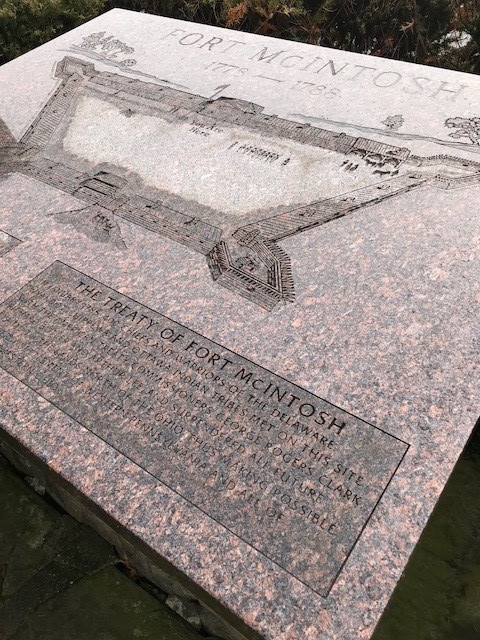
I was struck by a stone marker I read at one of our tour stops. The land where the cracker plant is being built was gained by treaty with the Delaware, Wyandot, Chippewa, and Ottawa Indian tribes. Its devastating to think of how we've abused the land, air, and water that was never ours to have.
We continued on our tour to Washington County, the most heavily fracked county in Pennsylvania. We saw fracking pads and waste water retention ponds within 900 feet of an elementary school. We heard about the mystery surrounding chemicals in fracking fluid and methane emissions, which the fracking operations fight not to disclose. We watched as several large trucks full of fracking waste merged onto a highway and wondered aloud what would happen if one of the trucks spilled it's contents.

We met a man and his son who live with a fracking well in their backyard. The man has suffered a brain tumor which robbed him of his sight in one eye. He has kidney disease and endocrine problems. His son is incontinent. He has learning and attention problems. He was burned by an unseen chemical in his bathtub water as a small child. We met a mother who's child has leukemia. We met a mother who has to keep air quality monitors in every room of her house to keep an eye on the particulate matter in her air. They can't drink their water. They're concerned about the animals on their farm. They are watching their land be poisoned in front of their eyes, but since the fracking well isn't technically on their land they have no legal recourse. No one can move because they can't sell their homes.

As our tour progressed, the fog lifted. The sun began to shine. And the shadows around the fracking industry lifted. I saw with clarity the lies, corruption, manipulation, and greed. The evil of putting profits over people was exposed. But I felt a small sense of relief that fracking wasn't going on in my backyard--my children were safe. And then three days after I returned home from Pennsylvania there was a natural gas pipeline explosion in Illinois that killed 2 people, a father and son working on their farm. If you don't think natural gas affects your community, think again.
But the fog is lifting. There is hope. There are dedicated activists like Moms Clean Air Force, Clean Air Council, and Protect Our Children fighting to shine light on this industry and protect our common land, air, and water. There are resources like the Oil & Gas Threat Map that can help you assess your family's risk. Don't be afraid to educate yourself about fracking, speak to your representatives, and write letters to the editor. Speak truth to power. The only way to make change is to do the hard work. We cannot turn a blind eye to our brothers and sisters suffering in Pennsylvania, or Texas, or Oklahoma. But if we work with one another, we can lift the fog together.
Saturday, April 8, 2017
Why the Future Energy Jobs Bill Should Matter to People of Faith {Earth Month Series}
This is post 2 of 5 in my Earth Month Series. You can find last week's post here.
In November 2016, after more than
two years of intensive negotiations, Illinois’ General Assembly passed the most
significant piece of climate and clean energy policy in the state’s history.
The Future Energy Jobs Act (SB2814; Public Act 99-0906) moves our
electric sector toward a more modern, low carbon economy. This bill is a
victory for people in every community across Illinois who deserve more jobs,
lower electric bills, and healthier air to breathe. It’s also a victory for
businesses in Illinois in the clean energy sector and across the economy, and a
signal to companies across the nation that Illinois is fertile ground for
growth in this field--a field growing 12 times as fast as the US economy.
The narrative on the bill has
incorrectly focused on aid given to a pair of nuclear plants*, but this bill is all about the future with major emphasis on energy
conservation and clean renewable energy. Approximately 70% of the funds from
the overall legislation will focus on kick starting clean energy, which dwarfs
the dollars going to aid the two nuclear plants, and will help chart the path
toward a clean, modern energy economy for decades to come—bringing tens of
thousands of new jobs, billions in private investments, cleaner air and needed
savings on monthly electricity bills, statewide.
What's especially exciting is that
this bill will open up opportunities to people in low-income communities who
too often have been shut out of participating in the clean energy economy. This
bill invests more than $750 million in low-income programs, including the Illinois Solar for All Program to prioritize new solar development and job
training in economically disadvantaged communities. Specific programs will
deliver job training and creation for returning citizens (ex-offenders) and foster care alumni.
So why should this matter to people of faith? Because this bill stands up for environmental and economic justice for
our neighbors and is a way to work toward healthier communities for all.
Illinois leads the US in the number of fossil fuel burning plants located in
communities of color. And low income residents use a higher percentage of their total expenses on energy than higher income families do. This legislation helps level the playing field, rids our air of pollution, and brings jobs to communities often left behind.
But this legislation needs your help. Though the Future Energy Jobs Act takes effect on June 1, 2017, it's in danger of losing its funding. The funds, called the Renewable Energy Resources Fund (RERF), are in danger of being swept into other programs because of the budget crisis. Sweeping these funds sweeps away the hope of lower utility bills, workforce development and job training, and cleaner air. I encourage you to call your state representatives about HR234/SB234 and ask them to protect the RERF funds.
While we wait for more solar and wind energy, you can still become a smart energy consumer. Learn how to use your smart meter or enroll in a Peak Time Rewards program or Power Smart Pricing program through Ameren. Or email me about bringing a Smart Energy Workshop to your house of worship.
*source: https://swww.nrdc.org/experts/nick-magrisso/future-energy-jobs-bill-path-illinois-bright-clean-energy-economy
Monday, January 23, 2017
Why I marched
On Saturday I drove my oldest two daughters up to Champaign/Urbana to participate in our local Women's March. We joined several thousand men, women, and children and met up with some female United Methodist pastor friends. Todd, feeling left out but home working on his sermon, decided to put Harper in the car and join us. The march was peaceful, inspiring, and energizing and I was glad I'd brought my family to participate. We had lunch at a local restaurant and spent time with our clergy friends. It was a beautiful afternoon, both literally and figuratively.

I've received some questions (and criticism) about my views on the march. It seems to some that my faith and position as a pastor's wife are at odds with my views on social justice. Or that it's unchristian to disagree with our leaders and that we'd all be better off just staying quiet and going along to get along.
Not coincidentally, my social justice views line up very closely with those of the United Methodist Church on many, but not all, causes I care about. But I thought I'd clarify why I marched and what I believe. I don't expect everyone to agree with me, but perhaps this post will spark a discussion or raise awareness or inspire compassion.
So here goes.
Some folks were fired up that pro-life groups were "banned" from marching. I'm a pretty skeptical person by nature, so I was watching closely for censorship or exclusion. I can tell you with certainty that I didn't see it happening and that the tone of the crowd was open and inclusive. No one was checking causes at the door. There was no door; all were welcome. That said, I'm not sure how the rally speakers were chosen; I was not part of the planning committee. What I do know was that the speakers were diverse in age, race, culture, and faith background and spoke on a number of topics like common sense gun legislation, Black Lives Matter, the environment, and reproductive rights.
Which brings me to this: the pro-life and pro-choice camps could do so much more if they could find a way to work together. We have much in common, and ultimately want the best for all women and children. I think Fr. James Martin said it best on a post on his Facebook page this weekend:
I've read a few people trying to paint me as pro abortion. This is false.
The march showed the intersectionality of all of the issues for which we marched. Environmental justice is connected to food justice and maternal/child health, which is connected to economic justice, which is connected to racial justice, which is connected to gender justice. No single issue drove this march. And as much as people wanted to say it was anti-Trump, it wasn't. We won't accomplish much if we march for what we're against rather than what we're for. And if we wait to march until we all agree, we'll never leave our homes.
I deeply hope that the numbers of folks who came out for the Women's March will also take the the streets the next time a black body is shot without cause, or when the water protectors at Standing Rock are assaulted, or when our common land and water is degraded by yet another oil spill, or when our government takes away programs that serve the most vulnerable among us in favor of tax breaks for the wealthy.
I hope that white men and women begin to understand their privilege and reach out to their brothers and sisters of color to listen and try and understand how different their experiences can be. I hope that instead of telling them, "Don't worry, everything will be OK", they'll really listen and ask what can be done to help. That's something I'm personally trying to work on, as I don't often hear from people of color where I live, because frankly, there aren't any.
I'm curious to hear your stories. I'm open to hearing your comments. I'd be happy to answer your questions.
But know this: even if we don't agree, I marched for you. I marched for your children. Because I know we only rise by lifting each other up.


I've received some questions (and criticism) about my views on the march. It seems to some that my faith and position as a pastor's wife are at odds with my views on social justice. Or that it's unchristian to disagree with our leaders and that we'd all be better off just staying quiet and going along to get along.
Not coincidentally, my social justice views line up very closely with those of the United Methodist Church on many, but not all, causes I care about. But I thought I'd clarify why I marched and what I believe. I don't expect everyone to agree with me, but perhaps this post will spark a discussion or raise awareness or inspire compassion.
So here goes.
Some folks were fired up that pro-life groups were "banned" from marching. I'm a pretty skeptical person by nature, so I was watching closely for censorship or exclusion. I can tell you with certainty that I didn't see it happening and that the tone of the crowd was open and inclusive. No one was checking causes at the door. There was no door; all were welcome. That said, I'm not sure how the rally speakers were chosen; I was not part of the planning committee. What I do know was that the speakers were diverse in age, race, culture, and faith background and spoke on a number of topics like common sense gun legislation, Black Lives Matter, the environment, and reproductive rights.
Which brings me to this: the pro-life and pro-choice camps could do so much more if they could find a way to work together. We have much in common, and ultimately want the best for all women and children. I think Fr. James Martin said it best on a post on his Facebook page this weekend:
I've read a few people trying to paint me as pro abortion. This is false.
I am pro life.
That means that I'm also pro social justice.
That means that I am not only for the dignity of the human being from the moment of conception, but also for the dignity of the human being until the natural end of life. For life does not end with birth. A person who is truly pro life is pro all life, pro every stage of life, pro every stage of life for every person. For all life is sacred, because all life is created by God.
That means that I support anything that helps a person live a full, healthy and satisfying life, in every part of the world. So I am for care for the poor, for a living wage, for affordable health care, for adequate housing, for a humane work environment, for equal pay for women, for generous child care, for the support of the aged and the infirm.
That means I support caring for the marginalized among us: the refugee, the migrant, the displaced person, the homeless, the unemployed, the person with disabilities, the single mother, women who are abused, minorities of every kind who are persecuted, and all those who feel left out, mocked, lonely, ignored or frightened.
That means that I am against torture, because it is an affront to human dignity. I am against the death penalty, the most serious affront to an adult life. I am against abuse and mistreatment in prisons. I am against war as a way to solve problems.
That means I respect the lives of all creatures, and am therefore for the care of the world in which we live, for the environment in the broadest sense.
That means I am pro peace, pro justice and pro reconciliation.
The longer I am a Jesuit, the longer I am a priest, the longer I live, and the more I pray and listen and observe, the more convinced I am of the sanctity and beauty of life.
So, yes, I am pro life. Pro all life.
I hope you are too.
The march showed the intersectionality of all of the issues for which we marched. Environmental justice is connected to food justice and maternal/child health, which is connected to economic justice, which is connected to racial justice, which is connected to gender justice. No single issue drove this march. And as much as people wanted to say it was anti-Trump, it wasn't. We won't accomplish much if we march for what we're against rather than what we're for. And if we wait to march until we all agree, we'll never leave our homes.
I deeply hope that the numbers of folks who came out for the Women's March will also take the the streets the next time a black body is shot without cause, or when the water protectors at Standing Rock are assaulted, or when our common land and water is degraded by yet another oil spill, or when our government takes away programs that serve the most vulnerable among us in favor of tax breaks for the wealthy.
I hope that white men and women begin to understand their privilege and reach out to their brothers and sisters of color to listen and try and understand how different their experiences can be. I hope that instead of telling them, "Don't worry, everything will be OK", they'll really listen and ask what can be done to help. That's something I'm personally trying to work on, as I don't often hear from people of color where I live, because frankly, there aren't any.
I'm curious to hear your stories. I'm open to hearing your comments. I'd be happy to answer your questions.
But know this: even if we don't agree, I marched for you. I marched for your children. Because I know we only rise by lifting each other up.
Thursday, October 27, 2016
Things we don't talk about
I recently heard Mark Charles, a Navajo speaker, writer, and advocate, give a lecture on the Doctrine of Discovery. The Doctrine of Discovery was when the Church in Europe, through a series of Papal Bulls from 1452-1493, instructed the nations of Europe to go and conquer lands and people not ruled by Christian rulers. These indigenous people were considered less than human, and their sacred lands were for the taking.
This attitude extends through our nation's history as reflected in the treatment of Native Americans from Columbus to present day, and is hiding in plain sight in our revered historical documents like The Declaration of Independence and The Constitution. And it's modern-day effects are being seen in the Dakota Access Pipeline opposition in South Dakota.
If this is news to you, I am sorry. I am sorry our educational system has not undertaken this difficult topic, and instead of using it as a starting point for healing it's been buried and forbidden. Many would prefer not to talk or think about it, proclaiming, "What does the past have to do with me? What am I supposed to do about it?" Many are ashamed of this part of our history, but by not working through it we may be doomed to repeat it. What we need is lament and reconciliation to our land and our native peoples.
One could argue that we live in a time where the question is not whether we are racist or not, but whether our racism is explicit or implicit. We are all racist, some of us are just better at navigating the language or posture around it. What we need now is to acknowledge it, shine a light upon it, and fix the broken parts within ourselves that allow us to think that we are somehow better than other sacred children of God.
Some of the vitriol we've seen this election season springs out of a frustration with not wanting to--or not having the vocabulary to--have the hard conversations needed to move forward: racism, sexism, xenophobia, and disregard for human life from cradle to grave are hard issues to tackle over coffee or Bible study. This is hard, holy work that will take a long, sustained effort. And we could learn a lot about effort from the Navajo.
In a break out session following his keynote speech, Mark Charles explained that Navajo time is not like "American" time. Instead of being oriented to time- and place-specific appointments on a calendar, Navajo are goal-oriented: they stay till the task is done, however long that takes. They do this out of love for the land and the desire to care for those around them.
That's what I've admired most about those gathered in South Dakota to resist the pipeline: they are prepared to be there until the task is complete and their goals are met. They've set up shelters, stores, even midwifery services! Those gathered and connected to the sacred ground are the true hosts and defenders of the Earth. They are showing us how to care for the land and preserve the water, because water is life. We should be listening and watching their example.
Is it any wonder we treat each other the way we do when we treat our land as a trash can or ATM machine? It's time to start talking. It's time to have the hard conversations. Though we won't fix it overnight, if we commit to work till the job is done, however long it takes, we can be reconciled to God, to one another, and to our Earth.
What hard conversations are you having lately? What hard conversations do you need to have?
This attitude extends through our nation's history as reflected in the treatment of Native Americans from Columbus to present day, and is hiding in plain sight in our revered historical documents like The Declaration of Independence and The Constitution. And it's modern-day effects are being seen in the Dakota Access Pipeline opposition in South Dakota.
 |
| The phrase "the merciless Indian Savages", hidden in plain sight in the Declaration of Independence. |
One could argue that we live in a time where the question is not whether we are racist or not, but whether our racism is explicit or implicit. We are all racist, some of us are just better at navigating the language or posture around it. What we need now is to acknowledge it, shine a light upon it, and fix the broken parts within ourselves that allow us to think that we are somehow better than other sacred children of God.
Some of the vitriol we've seen this election season springs out of a frustration with not wanting to--or not having the vocabulary to--have the hard conversations needed to move forward: racism, sexism, xenophobia, and disregard for human life from cradle to grave are hard issues to tackle over coffee or Bible study. This is hard, holy work that will take a long, sustained effort. And we could learn a lot about effort from the Navajo.
In a break out session following his keynote speech, Mark Charles explained that Navajo time is not like "American" time. Instead of being oriented to time- and place-specific appointments on a calendar, Navajo are goal-oriented: they stay till the task is done, however long that takes. They do this out of love for the land and the desire to care for those around them.
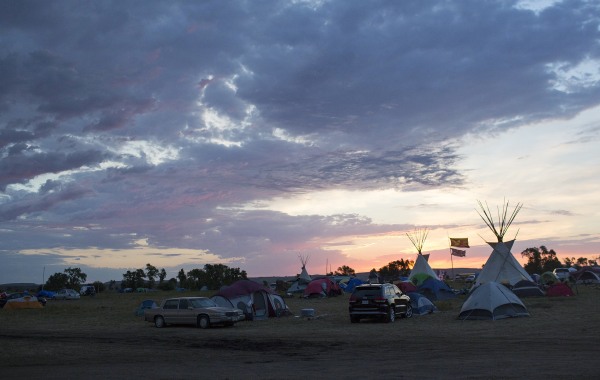 |
| "Hundreds of people, mostly Native Americans, gather near the Standing Rock Indian Reservation in North Dakota to protest the construction of an oil pipeline on Sept. 21. If completed, the Dakota Access Pipeline would transport 470,000 barrels of crude oil each day from North Dakota to Illinois." Jim Seida / NBC News |
That's what I've admired most about those gathered in South Dakota to resist the pipeline: they are prepared to be there until the task is complete and their goals are met. They've set up shelters, stores, even midwifery services! Those gathered and connected to the sacred ground are the true hosts and defenders of the Earth. They are showing us how to care for the land and preserve the water, because water is life. We should be listening and watching their example.
Is it any wonder we treat each other the way we do when we treat our land as a trash can or ATM machine? It's time to start talking. It's time to have the hard conversations. Though we won't fix it overnight, if we commit to work till the job is done, however long it takes, we can be reconciled to God, to one another, and to our Earth.
What hard conversations are you having lately? What hard conversations do you need to have?
Friday, July 22, 2016
Rescued but stranded
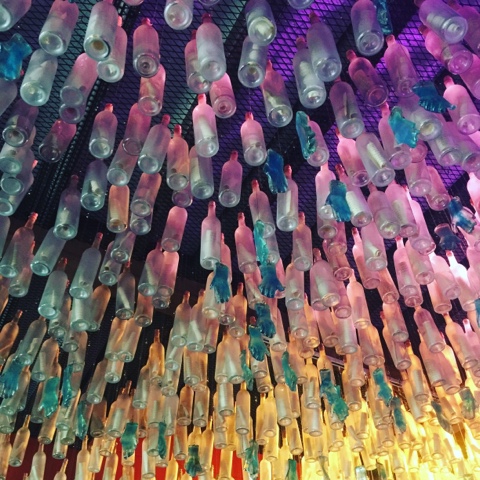
This memorial art installation greets you at as you enter the Beyond Katrina exhibit at The Presbytere in New Orleans. The bottles represent the dead. The blue hands represent the many helpers. The sense of floating you get standing beneath is disorienting, which I think is the point. So much about Katrina was about being un-tethered--to one's home, family, and culture. No one expected to not return home after the storm.
The bottles outnumber the hands, to be sure. The storm claimed many lives. But the hands are part of the story. Groups from near and far came to help in the recovery effort after Katrina. It's part of the beauty of what the city is now becoming--a resurrection story.
But there's another side to the story, too. Many people were rescued in the immediate aftermath of the storm only to be left stranded in places with no food or water. Those rescued were better off on dry land, of course, but they had no way to take the next steps in making a new life. They struggled to meet basic needs. It literally came down to where you got dropped off after your rescue and how adept you were at navigating a confusing, dangerous, and rapidly changing relief situation.
----------
I vividly remember sitting on my couch in Michigan, holding my new baby and weeping at the footage I was seeing on TV of the aftermath of Katrina. This was happening in America? I was an anxious mess for all the mothers there trying to feed, diaper, and comfort their babies without any means to do so. I was home that September day because I had opted not to work that school year so I could stay home with Madeline. And even though I had to work part-time in the evenings to help make up for my lost income, I had family to provide care for my daughter. Perhaps it was then that I began to realized my privilege.
In contrast is the story of my Uber driver who took me from the airport in New Orleans to the campus of Tulane University a few weeks ago. I asked her about her Katrina experience. She shared that she and her husband got out of their home in the 9th ward even before the mandatory evacuation was ordered, sending her small child in a car with her parents, hoping to catch up with them a few hours later. She didn't see her child again for two weeks. She was in the Superdome when the storm hit.
In the chaos that followed, she and her husband relocated to Houston and waited to be reunited with their child. Her second son was born in Houston a year later. The family barely scraped by. She hated it there. She eventually made her way back to the 9th ward and rebuilt her mother's house, which had been willed to her after her mother's death a few months before Katrina. Her marriage didn't last and her oldest child is again not with her, instead living with his father farther north in Louisiana.
She's trying to leave NOLA for good, hoping to return to Houston and find a job with the new degree she earned in social work, inspired by the many helpers she witnessed after the storm. She drives for Uber to help pay her bills while she figures out how to navigate finding a place to live, schools for her son, a job, and a support network far from home.
----------
As many wake up to the realities of racial injustice and inequality in
the United States, are we really surprised at what happened after Katrina? That an entire population of largely poor and African Americans was left to suffer and in some cases die because of lack of resources? Are we really comfortable blaming the victims, as is often the case when we don't know who else to blame?
My visit to New Orleans helped me understand that when we rescue in the short term we might strand future generations if we fail to
identify the things that caused the disaster in the first place and work
to fix them. But our current political climate has shown me that many in our country are not ready to get down to the bottom of our problems, opting instead for divisive words in shiny gold letters.
Can we be the helper hands? When we see institutional and economic racism that prevents people from getting ahead, do we speak up? When poor schools, lack of access to healthy food, polluted air, and poisoned water threaten any of us, they threaten all of us. We are stranding ourselves and our future.
We can use our voices and our votes. We can educate ourselves on social justice issues. We can listen. We can lament. We can pray. But we also must act.
Here's an example of what happens when our compassion leads us to action:
Thursday, June 30, 2016
Rooted
Last week I attended the GreenFaith Emerging Leaders Convergence in New Orleans alongside 60 interfaith leaders engaged in climate justice work from around the United States and Canada. We stayed on the campus of Tulane University and visited The Cabildo and the the Katrina and Beyond exhibit at The Presbytere in the French Quarter. And we traveled to Isle de Jean Charles, Louisiana to meet some of the first climate refugees in the United States. This is ground zero of climate change.
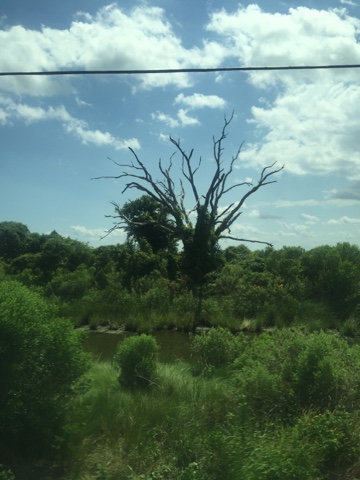
That's a cypress tree. It's likely been rooted in that spot for generations, much like the Biloxi-Chitimacha-Choctaw people that still live on the island today. But now it's dead. The salty water intruding upon the island from the Gulf of Mexico makes it impossible to survive there. So it holds its place in a disappearing land, receding because of man and nature and time. Who knows how much longer it will stand.
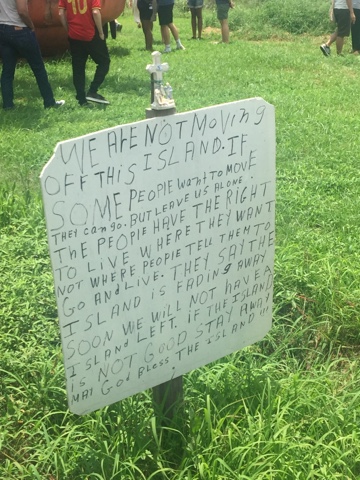
The residents want to stay. This is their ancestral home. They've existed by fishing the waters and farming the land for generations. They used native plants to heal. But the farmland is too wet and salty and they cannot graze animals. The medicinal plants are gone. The fishing waters are unsafe from oil spills and habitats are disappearing. Food, medicine, and other necessities must be accessed by a two lane road nearly at sea level, a slash of black in an open sea of blue that was land only 30 years ago.
So why do they stay? Why don't they just leave their homes in the sky and start over?
Why does anyone stay anywhere?
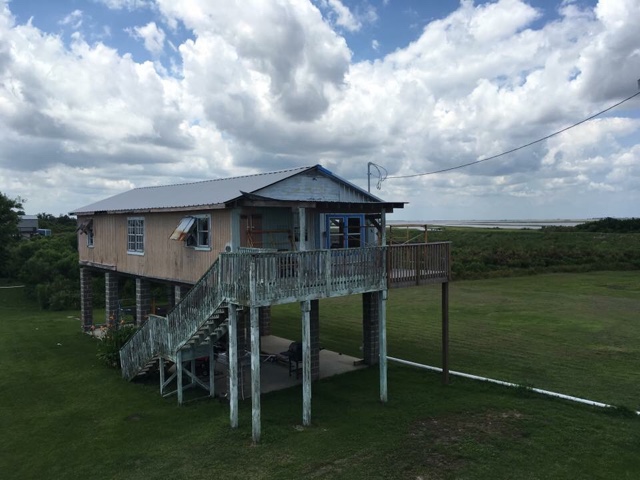
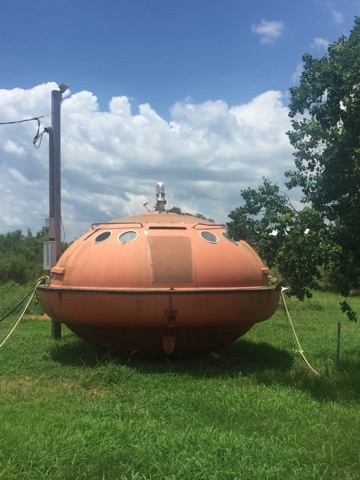
But life goes on. As our group was talking to Edison, the local man who penned the sign that both greets and warns visitors to the island, an ice cream truck passed by blaring Jingle Bells. There is still life here. There is hope. But there isn't much time.
We don't have an escape pod, like the one pictured above. There is no new planet for us to float away to once this one becomes uninhabitable. We only have this shared land, air, and water, and perhaps a common hope that as people of faith we can make a difference. We can right wrongs and speak truth to power. We can listen and hold space for the suffering of others. We can say with one voice that we will do better. And we can stay rooted to the words of our holy writings in the Bible and the Torah and the Qur'an and the Bhagavad Gita that the earth is sacred and that we are called to care for it and one another.
I'm encouraged by this young group of leaders. We're finding ways to bring back what we've learned to our communities across North America. We're connected by what we experienced. Though we are of many faiths, we're rooted in the hope that we can make a difference.
To what do you feel rooted?
That's a cypress tree. It's likely been rooted in that spot for generations, much like the Biloxi-Chitimacha-Choctaw people that still live on the island today. But now it's dead. The salty water intruding upon the island from the Gulf of Mexico makes it impossible to survive there. So it holds its place in a disappearing land, receding because of man and nature and time. Who knows how much longer it will stand.
The residents want to stay. This is their ancestral home. They've existed by fishing the waters and farming the land for generations. They used native plants to heal. But the farmland is too wet and salty and they cannot graze animals. The medicinal plants are gone. The fishing waters are unsafe from oil spills and habitats are disappearing. Food, medicine, and other necessities must be accessed by a two lane road nearly at sea level, a slash of black in an open sea of blue that was land only 30 years ago.
So why do they stay? Why don't they just leave their homes in the sky and start over?
Why does anyone stay anywhere?
Photo credit: Jennifer Rae Pierce
I can't pretend to understand; I'm not from here. The solutions are complex and emotional. But I think it's the same reason people in New Orleans "keep an axe in the attic", so in case the levees break and the waters rise families can escape to the roof until rescue comes, if rescue comes, because this is their home. They have roots here. And sometimes that's literally all you can grasp hold of when the storm surge comes.
Or maybe they just don't have anywhere else to go.
But life goes on. As our group was talking to Edison, the local man who penned the sign that both greets and warns visitors to the island, an ice cream truck passed by blaring Jingle Bells. There is still life here. There is hope. But there isn't much time.
We don't have an escape pod, like the one pictured above. There is no new planet for us to float away to once this one becomes uninhabitable. We only have this shared land, air, and water, and perhaps a common hope that as people of faith we can make a difference. We can right wrongs and speak truth to power. We can listen and hold space for the suffering of others. We can say with one voice that we will do better. And we can stay rooted to the words of our holy writings in the Bible and the Torah and the Qur'an and the Bhagavad Gita that the earth is sacred and that we are called to care for it and one another.
I'm encouraged by this young group of leaders. We're finding ways to bring back what we've learned to our communities across North America. We're connected by what we experienced. Though we are of many faiths, we're rooted in the hope that we can make a difference.
To what do you feel rooted?
Saturday, June 18, 2016
Faith without works is dead
Again. Another gun violence tragedy. I am simultaneously numb and livid. It's taken me nearly a week to get my thoughts out from my head onto this page.
 As my family did previously after the Sandy Hook massacre we will be completing 50 random acts of kindness, one for each of the victims. As Dr. Martin Luther King, Jr. said, "Hate cannot drive out hate; only love can do that." We will also be reading books to learn more about peacemaking and other religions. We attended a vigil sponsored by PFLAG Charleston.
I've also written my representatives about working for common sense gun legislation including assault weapon bans and background checks. Moms Demand Action for Gun Sense in America

I really don't know what to say except I am sorry.
I am sorry the victims are dead simply because they were out having a good time with people they loved.
I am sorry the killer had legal access to such a powerful and deadly weapon, and perhaps most lethal of all, an Internet connection.
I am sorry some families learned their loved one was gay and gone in the same breath.
I am sorry that I am part of a faith and denomination that has been complicit in making the LGBTQ community "other" rather than embracing them fully as children of God.
I am sorry that some Christian people feel the need to demonize all Muslims out of fear and ignorance.
I am sorry.
At times like this when harm has been done my Christian faith tradition calls me to identify my role in the harm done, to repent, and to work to repair the rift caused by my actions.
Though I may not be the one who pulled the trigger in this evil act, my silence and hesitancy to step out and lift up, protect, and affirm my LGBTQ brothers and sisters is just as dangerous. Not defending my Muslim brothers and sisters against the hateful speech being spewed against them is also wrong.
I am sorry.
But sorry is just a word.Thoughts and prayers are not enough. Faith without actions is dead (James 2:17).

I've also written my representatives about working for common sense gun legislation including assault weapon bans and background checks. Moms Demand Action for Gun Sense in America
and Everytown for Gun Safety have resources for talking to your elected officials on their websites and Facebook pages.
We will fight fear with facts. We will open our hearts, though our first instinct might be to close off. We will listen and learn. We will speak out when necessary.
Let there be peace on earth, and let it begin with me and my little family.
Monday, March 28, 2016
Love Stories from {The Root Collective}
I'm not particularly romantic or sentimental, so I think Valentine's Day is kinda meh. The gifts part, though? That I like.
But I do love a good love story. Like, just a notch above a supermarket romance novel but not quite as fancy as something written by the Brontë sisters. For me watching love unfold on a page is much, much more meaningful than watching a romantic comedy. There's just something honest but mysterious about having to imagine what the characters look or sound like. Sometimes I imagine myself or people I know in different roles in the book. I think it's more personal that way.
My favorite kinds of love stories lately? Ones about mothers and fathers in faraway places doing hard and brave things to better themselves and their families. That's a real love story with real life characters.
Here's one such story. Meet Alma.
From childhood, Alma was taught that she had no value. Her parents made it clear that she wasn't wanted. By the age of 9, she frequented the streets in Guatemala. By 12, she was going to clubs and began doing drugs. She was pregnant for the first time by the age of 13, though her child died in the womb after a violent beating from her boyfriend. Alma went on to have five children throughout her life, fathered by men who also didn't value her or her children. She was able to attend school through the sixth grade, but the subpar public school system left her unable to find sufficient work to support her children. She ended up joining a gang and thieved to feed her children. Her husband is now in jail. Alma started with the jewelry program with the microfinance portion of Lemonade Internation and has been able to turn her life around. She had the opportunity to change her circumstances and she took it, not just for herself, but to be an example for her children. Her dream is to see her children grow up without need of anything.
Love story. The best.
And another. Meet Pauline.
A young woman from Kenya, Pauline's story is one of determination. When she was only 16 and in the 6th grade, Pauline learned she was pregnant. She found herself needing to provide not only for herself and her new son, but – since her father had passed – also for her mother and 6 siblings. It was then that she came to the Neema Project in the hopes of learning a trade skill. She not only excelled in the skills she learned, but became a teacher in her own right. She taught the other students beadworking and how to fix and repair their errors. Pauline, now a graduate of the Neema Project, is working to support her family. She is ever hopeful of her future and the opportunities her employment will have for her son.
Two true love stories with real, relatable characters. And there are so many more. You can read more like them here.
The Root Collective partners with artisans trying to make a life for themselves and their children. It is not a charity. The artisans are equipped and trained to use their skills to make and sell their products and succeed in their business. The entire process, from the artisans to the good people at The Root Collective to the consumers who purchase their goods, is a circle of love. It's the best possible type of love story, where no one is rescued from their circumstance by a handsome prince but instead by their own hard work and ingenuity.
Looking for a meaningful or sentimental Valentine's Day gift for you or someone you love? Enter LOVESTORY at checkout for 15% off that my friends at The Root Collective created just for my readers. You can use my affiliate link to shop: http://www.idevaffiliate.com/32307/idevaffiliate.php?id=122.
I'll take these, in a 7.5.

Write your own love story this Valentine's Day by supporting someone else's.
Subscribe to:
Posts (Atom)


