Showing posts with label politics. Show all posts

Saturday, May 11, 2019

An invitation to a deeper conversation

Through my grassroots interfaith environmental advocacy, I’ve gotten to know lots of men and women in rural Illinois, which is very different from where I grew up in suburban Detroit.


I was raised Catholic, went through 12 years of Catholic education including an all-girls high school. And then I went to a United Methodist affiliated college and met a boy brought up in the United Methodist church. 


We started going to church together, and I started looking at the gospel in a different way. I saw women able to preach and lead congregations for the first time. I learned more about social justice in our first years of marriage than I’d learned in all my years of catechism.

  
This didn’t create tension in my family, but it did generate some deep discussions about how our faith informs our ideas and our politics on the environment, health care, reproductive rights, economics, and human sexuality, to name a few. Unsurprisingly, I didn’t always agree with my parents. Sometime I don’t entirely agree with my husband. But we’ve been able to develop some ground rules over the years:

  • You can always find common ground
  • Assume one another's best intentions
  • Look for nuance—not everything is black and white
  • Get comfortable with being uncomfortable
  • Ignoring it won’t make it go away   
  • I’m a beloved child of God and so are you
I’ve learned that not everyone goes through this kind of transformation. Not everyone learns how to engage in difficult or political conversations with grace. And some of us opt to stay out of it entirely in the interest of avoiding conflict. This rarely works and only reinforces that we simply don’t know how to TALK with each other about important issues.

All of this was on full display during the 2016 presidential election process and continues to color our country’s political discourse. And in February 2019, my heart broke as I watched my beloved church begin down a path of pain and exclusion.

When the hosts of a podcast I listen to wrote a book this winter, I Think You’re Wrong But I’m Listening: A Guide toGrace-Filled Political Conversations, I read it in nearly one sitting. I had been craving a new way to engage my friends and neighbors in difficult conversations, and this was it.

One of my favorite quotes from the book is this:

“We do not demonstrate love toward our neighbors by demonizing them over how they feel about tax policy or reproductive rights. We do not turn the other cheek when we treat politics as an insular sphere in which fighting fire with fire is the only way. We do not live as the hands and feet of a loving creator when we opt out of the processes that dictate roads and bridges, school curriculum and water treatment, war and peace. Neither stridence or apathy is a virtue.”

The book outlines many of the above rules I’ve employed over the years, and added a few more:

  • Take off your team jersey: ever get between a Cubs fan and a Cards fan? We need to learn to prioritize our relationship with the person we’re disagreeing with rather than our team. That also means prioritizing deep understanding of a topic of disagreement rather than winning, which brings us to #2:
  •  Get curious: does that thing you read on the internet seem completely unbelievable? Does it make you angry? Well…maybe it’s designed to. Do some research. Ask questions. If you’ve been watching the news lately, I think we’ve learned that social media has been used to manipulate our emotions and quite possibly our votes. Know that the truth might challenge your beliefs, which brings us to #3:
  •  Exit the echo chamber: Balance your news outlets and consider the source. If it’s not being shown on several major news outlets, that should give you pause. Time to get curious again and do some research. Take the opportunity to discuss the drama du jour with someone who might think differently than you. And again, make it your goal to deeply understand the topic, not score points for your side.
As people of faith, we’re called to be leaders in doing this well, or at least to try.

That's why I'm running to be a lay delegate to General Conference 2020. That's why I participate in the IGRC Unity group.  And that's why I want to be in conversation with you, dear reader, especially if you're a voting member of the Illinois Great Rivers Conference of the United Methodist Church. 

We have much to decide in 2020. The special General Conference rulings on human sexuality are only a small part of the things I'm passionate about: I am deeply concerned about our disregard for and abuse of creation, our reconciliation with our Native American sisters and brothers, and the status and role of women. I believe God will work with us in our decision making and will use our pain and our joy for good.

What is your hope for the United Methodist Church? Where is the pain? The joy? How are you being called to ministry? Who isn't being heard? 

I'd love to have these conversations in person or on the phone. I want to listen. I want to understand. Email me at christina.krost@gmail.com if you want to talk.




Friday, May 5, 2017

What I learned from arguing with a pig farmer

Recently I was invited to preach at a church near me about the importance of creation care. I carefully crafted a sermon that I thought was equal parts faithful, educational, and challenging. Though I was terrified for my first preaching experience, I thought it went well. At the very least I didn't die of embarrassment or pass out from nerves. I received positive feedback on my appearance (that's a blog post for another day), my speaking voice, and my message. I was thanked for my work and for teaching the congregation something new. Several people pledged to increase their efforts to reduce their carbon footprint. It was an encouraging day.

A few days went by and I received a phone call from one of the pastors. It seems one of the members of the congregation was enraged by my message and the pastor thought he was in need of  a follow up. So I gave him a call.

What happened next was perhaps the most formative experience I've had to date about how to have a difficult or emotionally-charged conversation with someone with which you disagree. Here's what I learned:

1. Listening to understand and listening to formulate a response are not the same thing.
I like to debate, and I like to win. But when you're trying to form or maintain relationships with people, you need to suspend this desire. The best thing I could do in this situation was to make sure the person felt heard. So I listened. This can be disarming to the person you're disagreeing with, because they're not expecting this grace.

I took time to let the pig farmer explain why he was so angry. I didn't interrupt. As it turned out, he wasn't even sure why he was angry. So I was able to ask some clarifying questions to direct our conversation.

2. How you say what you say matters.
I like to be right. And I felt deep-down that this gentleman was wrong. But instead of using a sarcastic tone or superior attitude, I remembered that he deserves the same respect and grace I do. I recently watched a Ted Talk by Sally Kohn in which she said, "You can be politically right but emotionally wrong". Your tone, attitude, eye contact, and body language can determine the outcome of a disagreement just as much as your words can.

My desire was to build a bridge with the pig farmer, not to win a match. And because this was technically a work interaction, I stayed in professional-mode. I gave him the benefit of the doubt--maybe he was having a tough day personally or professionally. Perhaps he was caught off guard that I actually called to talk and he was unprepared for such a conversation.  

3. Ask, "Why do you feel that way?"
In a recent episode of Ana Marie Cox's podcast With Friends Like These she talked about putting on her journalist hat during difficult discussions. She said that asking this question often shifted the tone of the conversation because a person stopped defending ideas and started embracing feelings. This can dramatically change the conversation. It can also yield important reasons why a person holds a particular view: a painful event from his/her childhood, a anecdote from a friend or family member, a deeply held fear. The listener can then begin to feel compassion for the person and perhaps see where this person is coming from in a new way. 


I asked the pig farmer this question late in our conversation. I should have started here. Some of the most useful parts of our conversation came from this line of questioning. I could hear the pain in his voice as he explained how difficult it is to make a profit in his industry and how a changing world and economy terrified him. It was then that I saw him as a real human person and not a stereotype.

4. Restate/explain/clarify your position
People hear things wrong. People connect dots that you don't intend for them to connect. So you may need to say, "let me make sure I understand what you're saying."


It turns out the the pig farmer has misheard me. He was so worked up about something I said early in the sermon that he missed an important connecting point later in my message. I offered to email him my manuscript. He declined, but I was glad I could offer that clarification.

5. Acknowledge that you both have rational, valid points even if you disagree.
This is perhaps the place where relationships are made or broken. Even if we disagree on a topic, we might have the same end goal in mind. We may each have a different vision of how to achieve these goals, and that is OK. It's important to find what we have in common and end on a positive note.

I discovered through our conversation that the pig farmer wanted to be more sustainable but that it wasn't always possible because of regulations or budget. But he listed several things he does at his farm to try to tread lighter on the earth. I do whatever I can to reduce my impact on the planet, too. I go about it a different way than he does, but we both are doing what we can. That's common ground. That's relationship building.

I've not spoken to the pig farmer again, but I am grateful for the lessons I learned from our conversation. And I'm hopeful that I could learn more about his industry and build a relationship with him in the future, as I have space in my friend list for a pig farmer.

So, how do you have difficult conversations? What would you add to this list? 

Monday, January 23, 2017

Why I marched

On Saturday I drove my oldest two daughters up to Champaign/Urbana to participate in our local Women's March. We joined several thousand men, women, and children and met up with some female United Methodist pastor friends. Todd, feeling left out but home working on his sermon, decided to put Harper in the car and join us. The march was peaceful, inspiring, and energizing and I was glad I'd brought my family to participate. We had lunch at a local restaurant and spent time with our clergy friends. It was a beautiful afternoon, both literally and figuratively.


I've received some questions (and criticism) about my views on the march. It seems to some that my faith and position as a pastor's wife are at odds with my views on social justice. Or that it's unchristian to disagree with our leaders and that we'd all be better off just staying quiet and going along to get along.

Not coincidentally, my social justice views line up very closely with those of the United Methodist Church on many, but not all, causes I care about. But I thought I'd clarify why I marched and what I believe. I don't expect everyone to agree with me, but perhaps this post will spark a discussion or raise awareness or inspire compassion.

So here goes.

Some folks were fired up that pro-life groups were "banned" from marching. I'm a pretty skeptical person by nature, so I was watching closely for censorship or exclusion. I can tell you with certainty that I didn't see it happening and that the tone of the crowd was open and inclusive. No one was checking causes at the door. There was no door; all were welcome. That said, I'm not sure how the rally speakers were chosen; I was not part of the planning committee. What I do know was that the speakers were diverse in age, race, culture, and faith background and spoke on a number of topics like common sense gun legislation, Black Lives Matter, the environment, and reproductive rights.

Which brings me to this: the pro-life and pro-choice camps could do so much more if they could find a way to work together. We have much in common, and ultimately want the best for all women and children. I think Fr. James Martin said it best on a post on his Facebook page this weekend:

I've read a few people trying to paint me as pro abortion. This is false.
I am pro life.
That means that I'm also pro social justice. 

That means that I am not only for the dignity of the human being from the moment of conception, but also for the dignity of the human being until the natural end of life. For life does not end with birth. A person who is truly pro life is pro all life, pro every stage of life, pro every stage of life for every person. For all life is sacred, because all life is created by God. 

That means that I support anything that helps a person live a full, healthy and satisfying life, in every part of the world. So I am for care for the poor, for a living wage, for affordable health care, for adequate housing, for a humane work environment, for equal pay for women, for generous child care, for the support of the aged and the infirm. 

That means I support caring for the marginalized among us: the refugee, the migrant, the displaced person, the homeless, the unemployed, the person with disabilities, the single mother, women who are abused, minorities of every kind who are persecuted, and all those who feel left out, mocked, lonely, ignored or frightened. 

That means that I am against torture, because it is an affront to human dignity. I am against the death penalty, the most serious affront to an adult life. I am against abuse and mistreatment in prisons. I am against war as a way to solve problems. 

That means I respect the lives of all creatures, and am therefore for the care of the world in which we live, for the environment in the broadest sense. 

That means I am pro peace, pro justice and pro reconciliation.
The longer I am a Jesuit, the longer I am a priest, the longer I live, and the more I pray and listen and observe, the more convinced I am of the sanctity and beauty of life.
So, yes, I am pro life. Pro all life.
I hope you are too.

The march showed the intersectionality of all of the issues for which we marched. Environmental justice is connected to food justice and maternal/child health, which is connected to economic justice, which is connected to racial justice, which is connected to gender justice. No single issue drove this march. And as much as people wanted to say it was anti-Trump, it wasn't. We won't accomplish much if we march for what we're against rather than what we're for. And if we wait to march until we all agree, we'll never leave our homes.

I deeply hope that the numbers of folks who came out for the Women's March will also take the the streets the next time a black body is shot without cause, or when the water protectors at Standing Rock are assaulted, or when our common land and water is degraded by yet another oil spill, or when our government takes away programs that serve the most vulnerable among us in favor of tax breaks for the wealthy.

I hope that white men and women begin to understand their privilege and reach out to their brothers and sisters of color to listen and try and understand how different their experiences can be. I hope that instead of telling them, "Don't worry, everything will be OK", they'll really listen and ask what can be done to help. That's something I'm personally trying to work on, as I don't often hear from people of color where I live, because frankly, there aren't any.

I'm curious to hear your stories. I'm open to hearing your comments. I'd be happy to answer your questions.

But know this: even if we don't agree, I marched for you. I marched for your children. Because I know we only rise by lifting each other up.


Thursday, October 27, 2016

Things we don't talk about

I recently heard Mark Charles, a Navajo speaker, writer, and advocate, give a lecture on the Doctrine of Discovery. The Doctrine of Discovery was when the Church in Europe, through a series of Papal Bulls from 1452-1493, instructed the nations of Europe to go and conquer lands and people not ruled by Christian rulers. These indigenous people were considered less than human, and their sacred lands were for the taking.

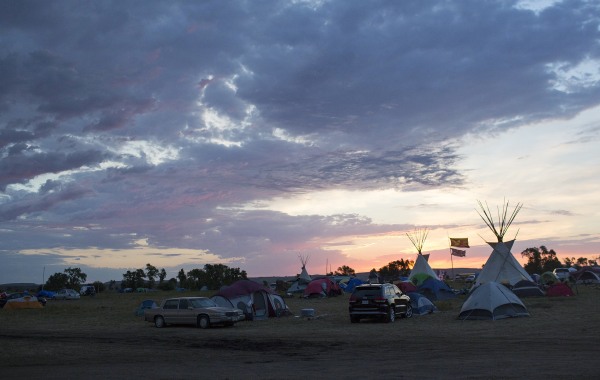
This attitude extends through our nation's history as reflected in the treatment of Native Americans from Columbus to present day, and is hiding in plain sight in our revered historical documents like The Declaration of Independence and The Constitution. And it's modern-day effects are being seen in the Dakota Access Pipeline opposition in South Dakota.

The phrase "the merciless Indian Savages", hidden in plain sight in the Declaration of Independence.
If this is news to you, I am sorry. I am sorry our educational system has not undertaken this difficult topic, and instead of using it as a starting point for healing it's been buried and forbidden. Many would prefer not to talk or think about it, proclaiming, "What does the past have to do with me? What am I supposed to do about it?" Many are ashamed of this part of our history, but by not working through it we may be doomed to repeat it. What we need is lament and reconciliation to our land and our native peoples.

One could argue that we live in a time where the question is not whether we are racist or not, but whether our racism is explicit or implicit. We are all racist, some of us are just better at navigating the language or posture around it. What we need now is to acknowledge it, shine a light upon it, and fix the broken parts within ourselves that allow us to think that we are somehow better than other sacred children of God.

Some of the vitriol we've seen this election season springs out of a frustration with not wanting to--or not having the vocabulary to--have the hard conversations needed to move forward: racism, sexism, xenophobia, and disregard for human life from cradle to grave are hard issues to tackle over coffee or Bible study. This is hard, holy work that will take a long, sustained effort. And we could learn a lot about effort from the Navajo.

In a break out session following his keynote speech, Mark Charles explained that Navajo time is not like "American" time. Instead of being oriented to time- and place-specific appointments on a calendar, Navajo are goal-oriented: they stay till the task is done, however long that takes. They do this out of love for the land and the desire to care for those around them.

Image:
"Hundreds of people, mostly Native Americans, gather near the Standing Rock Indian Reservation in North Dakota to protest the construction of an oil pipeline on Sept. 21. If completed, the Dakota Access Pipeline would transport 470,000 barrels of crude oil each day from North Dakota to Illinois." Jim Seida / NBC News

That's what I've admired most about those gathered in South Dakota to resist the pipeline: they are prepared to be there until the task is complete and their goals are met. They've set up shelters, stores, even midwifery services! Those gathered and connected to the sacred ground are the true hosts and defenders of the Earth. They are showing us how to care for the land and preserve the water, because water is life. We should be listening and watching their example.

Is it any wonder we treat each other the way we do when we treat our land as a trash can or ATM machine? It's time to start talking. It's time to have the hard conversations. Though we won't fix it overnight, if we commit to work till the job is done, however long it takes, we can be reconciled to God, to one another, and to our Earth.

What hard conversations are you having lately? What hard conversations do you need to have?

Saturday, October 8, 2016

Lost in translation


Jesus told his disciples: “There was a rich man whose manager was accused of wasting his possessions.  So he called him in and asked him, ‘What is this I hear about you? Give an account of your management, because you cannot be manager any longer.’
“The manager said to himself, ‘What shall I do now? My master is taking away my job. I’m not strong enough to dig, and I’m ashamed to beg— I know what I’ll do so that, when I lose my job here, people will welcome me into their houses.’
“So he called in each one of his master’s debtors. He asked the first, ‘How much do you owe my master?’
“‘Nine hundred gallons of olive oil,’ he replied.
“The manager told him, ‘Take your bill, sit down quickly, and make it four hundred and fifty.’
 “Then he asked the second, ‘And how much do you owe?’
“‘A thousand bushels of wheat,’ he replied.
“He told him, ‘Take your bill and make it eight hundred.’
“The master commended the dishonest manager because he had acted shrewdly. For the people of this world are more shrewd in dealing with their own kind than are the people of the light. I tell you, use worldly wealth to gain friends for yourselves, so that when it is gone, you will be welcomed into eternal dwellings.  
John 16:1-9
 
------

I was asked to prepare a children’s message on the above scripture recently. I realized it would be a tough and nuanced concept to try to explain to kids (and maybe even adults) in a 10 minute time slot. As I got down to business, I realized there was a major difference in my translations of this particular chapter--It’s titled “The Parable of the Shrewd Manager” in the NIV version, but “The Parable of the Crooked Manager” in The Message. The words shrewd and crooked evoke dramatically different feelings for me, so I got to wondering: is one better than the other? Would that chapter title alone sway how I feel about the manager and his actions?

In a country currently fueled by political and ideological division, it’s a valid question. As I write this, the 24-hour news cycle is again abuzz with shocking and unforgivable words caught on tape from the Republican presidential candidate. Many are defending and dismissing Trump’s words and actions as “out of context” or “media bias”, and I’m not writing to dispute or affirm those claims. I am, however, asking the following question: what makes one person shrewd but another crooked? Who decides, and how?

We’re faced with a difficult choice this election season. Though I will proudly cast my vote for Hillary Clinton and believe she is ready to lead this country with experience and compassion, she is not perfect. Women in power don’t get there without having learned to play hard ball, and I fear she is being held to a higher standard than that which we hold our male leaders.

Donald Trump, in contrast, is not ready to lead. He has no political experience, and his highly touted business acumen isn’t fully known since he won’t release his tax returns. While Clinton has a vast legislative record we can analyze (sometimes to her benefit, but sometimes not), we do not have the same abundance of material for Trump. An absence of a record doesn’t make him a better candidate (or a better person), it makes him a question mark and a liability. Frankly, he scares me.

I’ve seen a lot of folks—Christian folks, even—try to defend Trump with the argument that Hillary isn’t a saint, either. Both candidates are undesirable in some ways and in need of grace and possibly even repentance in others. But badness in someone else doesn’t make your bad less bad. Bad is still bad.

What we need to look at is fruit—has any good come from this imperfect person? Where is his/her heart? Is that reflected in his/her words and deeds? The shrewd/crooked manager in John took his influence and used it to better his situation so that once he lost his job he’d potentially have allies or at least a sympathetic business contact. He reduced the debt of others, which is a good thing, to make them more likely to help him, which could potentially be a bad thing. Not much different that politics these days, no? As Ecclesiastes says, there is nothing new under the sun.  

The Bible gives Christians much to debate, but there is even more that is clear cut and universally understood: blessed are the poor, the meek, the merciful, the peacemakers, and the persecuted. That, friends, is never lost in translation. 


BLOGGER TEMPLATE BY DESIGNER BLOGS