Sunday, July 12, 2015

Staying Connected

Image taken from Imdb.com

On a recent date night, my handsome husband took me to see Pixar's new film Inside Out. It's about a little girl and her emotions. I'll admit, I feel like I'm kind of an expert in this area already with three dramatic daughters at home, but the movie made an impression on me.

Riley, the pre-adolescent main character, moves with her family from an idyllic Minnesota childhood filled with friends, family, and hockey to bustling San Francisco to support her father's new business enterprise. Things do not go smoothly. Even the strongest of family units can be jarred by the stress of relocating, and cracks begin to show in Riley's family almost immediately. The moving truck is delayed, the new house and school aren't exactly what Riley had expected, and Riley's dad is overwhelmed with setting up his new business and investors.

The movie dives into what is going on in Riley's head as she forms new memories and attachments in her new home. The characters Joy, Anger, Sadness, Disgust, and Fear all play parts in forming her new identity. She is trying to make new connections to old ideas, to the things that make her uniquely her--her friends, her sense of humor, her love of hockey, her family. But these old pieces of her identity are being seriously strained. She misses her old friends. She struggles to try out for a new hockey team. She's not feeling like her silly self. And it seems like her family unit has been irreparably damaged. She just wants things to go back to the way they were. 

The most important pieces of Riley's identity become untethered until all that's left is her family, and even that is hanging by a thread. But then a strange thing happens: she begins to form new islands of her personality. And the old ones return--a bit different, but still there. Who Riley is is a fluid thing, influenced by her new environment, but no less beautiful than before--just different. 

I think ministry life is a lot like the movie Inside Out, and I encourage you to see it for yourselves. Appointments and the friends and support network that go along with them are in a regular state of flux. It might feel after a particularly difficult meeting or big move that you are unsure of who you even are anymore.  But as you undoubtedly know already, you are always growing and changing, becoming the person God is shaping you to be. Sometimes this change comes easily, like adding honey to your tea--the addition makes the end result sweeter and more comforting. But sometimes this change is hard, like boiling water for pasta--messy, hot, and time-sensitive, but eventually everything softens.

When change comes, it can be helpful to maintain meaningful connections to the things that make us us--friends, family, pets, and hobbies. Social media like Facebook and Twitter has made it easier than ever to stay connected with friends and family. My family finds it helpful to stay in contact with old friends through Face Time or Skype. We try to combine new as well as old when we move, so that there is familiarity along with the newness--same bedspread but new curtains, for instance. Maintaining routines, like morning prayers and devotions or keeping a regular sabbath, can also help.

We also add people to "our tribe" in each community we live, forming a beautiful and varied network of support everywhere we go. We do this through inviting other young families in our church or nearby clergy to dinner once a week, or by striking up conversations with people we meet at the park or grocery store. I'll admit that this is easy with young children, as they are a reliable source of conversation starters, but you'd be surprised how much you have in common with people once you start talking. That "me, too!" moment is the best feeling of connection I know.

You don't need to be in ministry to experience these issues! Tell me: how do you maintain meaningful connections during challenging times?

Wednesday, July 1, 2015

Year in ministry {2015 edition}

It is important to periodically take stock of your life and work. Are you achieving the goals you've set for yourself? Most of us do this in January at the turn of the New Year (and I'm no exception). But for those in ministry, July is when we review and renew, as most appointments begin and end July 1. 

Each year that we've been in ministry I've compiled a photo collage of the highlights of our year (you can find 2013 here and 2014 here ). This year's collage is below:


If you had to make a collage of your year so far, what would you include? What would you leave out? What work is still in progress?

Saturday, June 27, 2015

All or nothing

There's this scene in The Incredibles, Pixar's 2004 hit (and one of my top 10 favorite movies) where the evil villain Syndrome reveals his evil plot to the superhero family trying to stop him:


When everyone's super, no one will be.

And I get it. Our kids are growing up in a world where every t-ball team wins, every participant on the soccer team gets a trophy. And we wonder if it makes our kids "soft" not to feel the occasional sting of defeat or disappointment. 

It's as if letting everyone be happy makes some of us feel sad.

When the Supreme Court ruled in favor of marriage equality this week, I was personally glad. But I knew some of my friends, family, and church members would feel differently. And that's OK. Unsurprisingly, social media was abuzz with both support and condemnation for the SCOTUS decision. Some comments were so awful that Rachel Held Evans issued this public service announcement:


And in the comments of this post, I read the following anecdote:


Are we afraid we'll be less special, less loved by God, if everyone is? I'm pretty sure God has enough love to go around. And when I die and stand in judgment, I'm perfectly secure knowing I chose loving all over loving only those like me. And even if I'm wrong, I'd live my life the same way again.

Some of you may argue that loving everyone doesn't mean accepting their sins or extending them the same rights as everyone else. And history has shown we're pretty stingy with our inclusion: it took a bloody civil war to stop us from owning other people, which was justified because we held that black people were an inferior race. We took the land from and destroyed the way of life of our native brothers and sisters because we considered them savages. Women were not granted the right to vote until 1920. We still haven't agreed as a country, founded by immigrants, what to do about immigration.  

But our exclusion and grace gate-keeping limits our ability to experience and share God's love. 

Still not comfortable with marriage equality? 

Bishop Warner H. Brown Jr., president of the United Methodist Council of Bishops, issued a statement responding to the decision by the United States Supreme Court. He writes: "This Supreme Court decision calls attention to the difference between the laws of the United States, and the policy of our church,” Brown wrote. “The law does not require anyone to violate their conscience of what God has called them to do, or their theological understanding. But, if we seek to be an inclusive church that serves all of our parishioners, and all of our neighbors, we will have to consider how we treat all people equally.”

In simple terms that means that this decision cannot force any religious institution or clergy member to perform a same-sex marriage if it is against their beliefs. Rather, the right of marriage is extended to all, but it will be up to the couple to find a church or other location to perform the ceremony.  

Your rights are not being violated because they've been extended to everyone. The institution of marriage, which is on shaky ground at best in the U.S., will not be destroyed by allowing same-sex couples to marry. 

Unless all of us are equal, none of us will be. 

Friday, June 19, 2015

Lighting a candle AND cursing the darkness

I am still stunned by what happened in Charleston. As I typically do when these things happen--and they happen far too often in this country--I go to people I trust to help process my feelings. 

One of my favorite people, Sarah Bessey, posted this to her Facebook page:


And I thought YES. THIS IS HOW I FEEL.

As I scrolled through the comments to her post, I noticed that people were commenting on the power of the word "and". The word "and" helps link the dichotomy of human emotion. 

You can be brave AND scared.
You can feel excited AND cautious.
You can be standing in a crowd AND still feel lonely.
You can like Coke AND Pepsi.

Humans are mysterious like that.

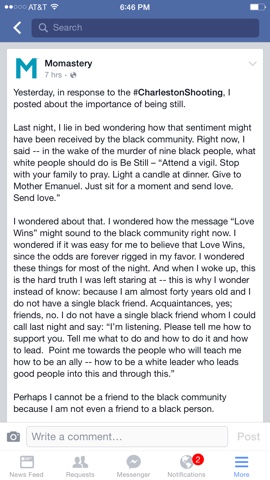
Then I read this from Glennon Melton of Momastery:


And I thought, yes! This is me! I want to help AND I am afraid of saying or doing something very unhelpful.

And then I read Kristen Howerton of Rage Against the Minivan's post: 


And I knew that I could help in a small way AND learn something in the process. 

This is a small little blog. Sometimes my posts get 300 views, sometimes 50. But I don't want to squander what little influence I have. 

If you're willing to talk, I'm willing to listen.

We can grieve AND be angry. 
We can wrestle with our race issues AND still be respectful.
We can desire equality AND be unsure of what that really means. 
We can acknowledge white privilege AND not understand it. 
We can learn about gun control issues AND still honor our constitutional rights.
We can ask hard questions AND not be offended when we get honest answers.
We can love Jesus AND not know how to follow Jesus.

But we cannot be outraged AND do nothing. 

Light a candle AND curse the darkness. 


Thursday, June 11, 2015

Brightening the Chain

This week my family attended the Illinois Great Rivers Annual Conference of the United Methodist Church at the Peoria Civic Center. It's part business meeting, part worship, part reunion for the clergy and laity of the IGRC. For pastors, this is their church. They support and encourage each other and have a chance to listen and absorb sermons and speakers instead of preparing them. 


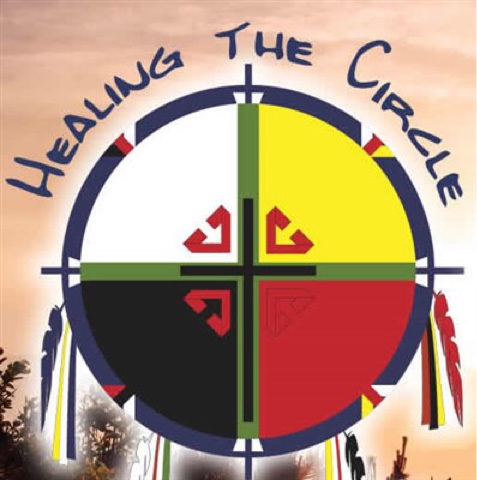
The theme of Annual Conference this year was Healing the Circle: Godly Sorrow Brings Repentance. We listened to the hard truths of what was done to American Indians, often in the name of God, historically and in present-day. And as is often the case when discussing painful things, I found myself squirming in my seat as the speakers told of unimaginable things done to native peoples in the name of westward expansion and progress. 

Rev. Fred Neeake Shaw, a retired UMC pastor from Ohio and co-chair of the North Central Jurisdictional Committee on Native American Ministries, spoke first. He called our attention to circles: all things are equal when you stand in a circle. The most important things in life are circles: hugs, families, stars, the Earth. Repentance is a circle, too--between us and God. True repentance means we go in a different direction out of love and caring for those we've hurt. 

Rev. Shaw introduced the metaphor of "brightening the chain". Native Americans recognized that European chains were stronger than ropes, but that they needed to be repaired and polished periodically. So, too, is our relationship with God and one another. He reminded us that those sitting in the pews of our churches today are the link between the saints that have gone before and the ones to come. Rev. Shaw implored us to not be the link of the chain that breaks.

Rev. Dr. Thin White Wolf Fassett, emeritus General Secretary of the General Board of Church and Society of The United Methodist Church, spoke the following day. He reminded us of our interconnectedness to each other and to the natural world. He stated that "history is theology", but that we don't often talk about those connections.

Rev. Fassett discussed repentance not as something we talk about, but something we do. It's not sexy or fun, but it's critical to healing and reuniting the circle. 

This year, the IGRC had some difficult legislation to tackle. Perhaps the most heartbreaking decision made was to sell three camps owned by the conference and put the profits toward updating and promoting the two remaining camps. Many clergy and laity owe their spiritual lives to such camps. To sacrifice one camp to save another is an enormously emotional decision, but it's also a real-life example of "brightening the chain". 

At church camp we train our children to see our interconnectedness to each other and to nature, but our camping ministry is suffering. In order to save it, broken links have been removed. The remaining links will be polished and put in place, hopefully for many years to come. 

The vote was not easy or fun, and when the legislation passed there was no celebration. A season of repentance will need to occur to heal the circle between us, God, our camping ministry leaders, and our campers. Only then can we move forward. 

The United Methodist church is in a season of uncertainty and division, but I know I don't want to be the chain that broke. My link in the chain of God's family holds together generations of believers. Though I may be rusty or barely holding on, I will continue to keep linking arms. That doesn't mean there won't be hard decisions or mistakes or repentance, but I won't stop trying to hold the circle together. 

In what areas of your life do you need to "brighten the chain"? Where do you need to heal the circle?

 
BLOGGER TEMPLATE BY DESIGNER BLOGS