Saturday, October 8, 2016

Lost in translation


Jesus told his disciples: “There was a rich man whose manager was accused of wasting his possessions.  So he called him in and asked him, ‘What is this I hear about you? Give an account of your management, because you cannot be manager any longer.’
“The manager said to himself, ‘What shall I do now? My master is taking away my job. I’m not strong enough to dig, and I’m ashamed to beg— I know what I’ll do so that, when I lose my job here, people will welcome me into their houses.’
“So he called in each one of his master’s debtors. He asked the first, ‘How much do you owe my master?’
“‘Nine hundred gallons of olive oil,’ he replied.
“The manager told him, ‘Take your bill, sit down quickly, and make it four hundred and fifty.’
 “Then he asked the second, ‘And how much do you owe?’
“‘A thousand bushels of wheat,’ he replied.
“He told him, ‘Take your bill and make it eight hundred.’
“The master commended the dishonest manager because he had acted shrewdly. For the people of this world are more shrewd in dealing with their own kind than are the people of the light. I tell you, use worldly wealth to gain friends for yourselves, so that when it is gone, you will be welcomed into eternal dwellings.  
John 16:1-9
 
------

I was asked to prepare a children’s message on the above scripture recently. I realized it would be a tough and nuanced concept to try to explain to kids (and maybe even adults) in a 10 minute time slot. As I got down to business, I realized there was a major difference in my translations of this particular chapter--It’s titled “The Parable of the Shrewd Manager” in the NIV version, but “The Parable of the Crooked Manager” in The Message. The words shrewd and crooked evoke dramatically different feelings for me, so I got to wondering: is one better than the other? Would that chapter title alone sway how I feel about the manager and his actions?

In a country currently fueled by political and ideological division, it’s a valid question. As I write this, the 24-hour news cycle is again abuzz with shocking and unforgivable words caught on tape from the Republican presidential candidate. Many are defending and dismissing Trump’s words and actions as “out of context” or “media bias”, and I’m not writing to dispute or affirm those claims. I am, however, asking the following question: what makes one person shrewd but another crooked? Who decides, and how?

We’re faced with a difficult choice this election season. Though I will proudly cast my vote for Hillary Clinton and believe she is ready to lead this country with experience and compassion, she is not perfect. Women in power don’t get there without having learned to play hard ball, and I fear she is being held to a higher standard than that which we hold our male leaders.

Donald Trump, in contrast, is not ready to lead. He has no political experience, and his highly touted business acumen isn’t fully known since he won’t release his tax returns. While Clinton has a vast legislative record we can analyze (sometimes to her benefit, but sometimes not), we do not have the same abundance of material for Trump. An absence of a record doesn’t make him a better candidate (or a better person), it makes him a question mark and a liability. Frankly, he scares me.

I’ve seen a lot of folks—Christian folks, even—try to defend Trump with the argument that Hillary isn’t a saint, either. Both candidates are undesirable in some ways and in need of grace and possibly even repentance in others. But badness in someone else doesn’t make your bad less bad. Bad is still bad.

What we need to look at is fruit—has any good come from this imperfect person? Where is his/her heart? Is that reflected in his/her words and deeds? The shrewd/crooked manager in John took his influence and used it to better his situation so that once he lost his job he’d potentially have allies or at least a sympathetic business contact. He reduced the debt of others, which is a good thing, to make them more likely to help him, which could potentially be a bad thing. Not much different that politics these days, no? As Ecclesiastes says, there is nothing new under the sun.  

The Bible gives Christians much to debate, but there is even more that is clear cut and universally understood: blessed are the poor, the meek, the merciful, the peacemakers, and the persecuted. That, friends, is never lost in translation. 


Monday, October 3, 2016

Fair Trade Month Giveaway!

October is Fair Trade Month. If you've followed the blog for any amount of time you know how much I love fair trade companies. I've written about and personally own items from companies like The Root Collective, Noonday Collection, FashionABLE, Sseko, Better Life Bags, The Giving Keys, and People Tree. I also purchase fair trade chocolate and coffee. I believe in the mission of fair trade and ethical companies and know how I spend my dollars matters and sends a message.

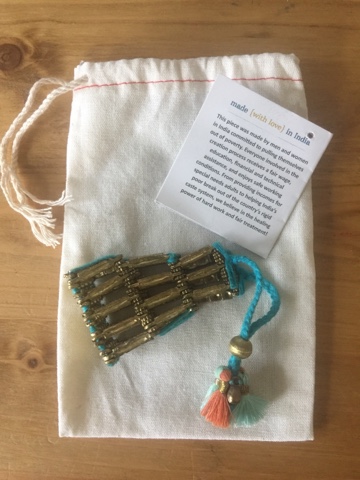
I recently hosted a Noonday Collection Trunk Show and received a bracelet as a hostess gift, and having bought several bracelets recently, I thought maybe my dear readers might like to have it instead. So here's my first Fair Trade Month giveaway: the Arabian Sea Bracelet!


Here's how to enter:
1. Post a comment below with your favorite fair trade company and product. Add a link if you can. You can post as often as you like! Feel free to share this post with your friends, too. 
2. I'll randomly choose a commenter at noon on Friday, October 14. I'll email the winner to arrange shipping or pick up.

Good luck! And thank you for supporting fair trade and ethical companies!


Friday, September 30, 2016

Send in your second


I'm among the millions of Americans obsessed with the musical Hamilton. You might even say I'm #ham4ham. There's much to love about Lin-Manuel Miranda's masterpiece, which tells the story of the rise of founding father Alexander Hamilton,whose life is intertwined with and ultimately ended by Aaron Burr in a duel. I'm particularly fascinated with the darker aspects of the show: the dueling, and in particular, the idea of a "second".


So I did some research. According to PBS:

"In a typical duel, each party acted through a second. The seconds' duty, above all, was to try to reconcile the parties without violence. An offended party sent a challenge through his second. If the recipient apologized, the matter usually ended. If he elected to fight, the recipient chose the weapons and the time and place of the encounter. Up until combat began, apologies could be given and the duel stopped. After combat began, it could be stopped at any point after honor had been satisfied."

Here's more about seconds from a random website with a dueling-themed t-shirt:

"...The role of the dueling second was crucial and necessary to the duel– the role of a second contributed to the legitimacy of the duel itself, because his presence alone made it virtually impossible for the dueling parties to stage a fake or illegitimate duel. The principal had to choose his second wisely because not only was the second responsible for negotiating the terms of the duel, but he had to be present to ensure that the duel was conducted with honor by both parties. A Dueling second, according to Code Duello, had the right to intervene and join in a duel if he felt that the duel was not facilitated in good faith. Therefore, it was an honor to be chosen a second." 

In the musical, the duel which took Hamilton's life was precipitated by Hamilton's endorsement of Thomas Jefferson for President over Aaron Burr in the election of 1800, which Aaron Burr took as a personal slight. Both characters had past experiences with duels and thought them childish and immature. But in the end, satisfaction of honor prevailed over common sense and Hamilton's story was cut short.

As I've served churches alongside my husband, I've noticed many Christians are afraid of conflict. Conflict itself isn't bad, but how we handle it can be. If we had to loop in two other parties to settle an argument, would that help? In an age where independence is highly valued, do we think acting through a second is weak? Gossipy?

If I'm being completely honest, I have no idea who I'd choose as my second if I were challenged to a duel tomorrow. Do you? It confirms a belief I've held for a while that our connections to people in our modern age of social media and globalization are more wide than deep, more acquaintance than friend. As I've gotten older, I've gained many Facebook friends and Twitter followers but have lost the real, deep friendships I enjoyed in high school and college. Chalk it up to busyness or itinerancy or a particular stage of parenting, but it's true for me and I'd wager it's been true for you at some point in your life: we don't have seconds anymore.

In contentious business or legal matters we use mediators. Both parties in a troubled marriage might turn to a counselor for guidance. In church, we might convene a committee to work through a problem. These are modern-day seconds.

Social media is the modern dueling ground. It's easier than ever to wound (though not mortally) an offending party. But without our trusty second giving us the time and space to process or a time and a place to settle it, we can make rash decisions that can have long-acting consequences. I'm not saying dueling is a better system, but at least the duelists could see their enemy. They could look him in the eye, and so could their second. These days, we hide behind screens and hurl our insults at both no one and everyone in moments flat.

Do we need to bring back seconds? Who is your second?

Friday, September 2, 2016

Best seat in the house

So. many. questions. all the time.
I think I am socially awkward. I'm a textbook extrovert, meaning I get energy from spending time with other people rather than by being by myself, but I'm not always graceful about it. I never know where I fit in the social hierarchy of people at a party (or a meeting, or a conference, or a worship service, or a small group...), and my inner dialog goes, "am I just the spouse of an invited guest, a close friend of the hostess, just an acquaintance, in the wrong place entirely? WHERE DO I SIT?" I've written about this awkwardness before.

So I was relieved to learn that I'm not alone. I recently heard a story on NPR that confirmed my suspicions that humans are not always good at defining friendships or social relationships. In fact, we're really bad at it. Studies have shown that about half the time, people we consider to be our closest confidantes don't feel the same way about us and might not even include us in a list of their top 5 friends. Half the time! It's not just in my head. Awkward high school lunch table survivors, unite!

Todd preached on Luke 14:7-11 last Sunday, and I realized that Jesus had something to say about seating chart politics, too:  
When he noticed how the guests picked the places of honor at the table, he told them this parable: "When someone invites you to a wedding feast, do not take the place of honor, for a person more distinguished than you may have been invited. If so, the host who invited both of you will come and say to you, ‘Give this person your seat.’ Then, humiliated, you will have to take the least important place. But when you are invited, take the lowest place, so that when your host comes, he will say to you, ‘Friend, move up to a better place.’ Then you will be honored in the presence of all the other guests. For all those who exalt themselves will be humbled, and those who humble themselves will be exalted.”
In Jesus' time, banquets or wedding feasts were all about the social hierarchy. Where one sat was an outer sign of one's status. Greco-Roman society did not consider humility a virtue, but Jewish law in the book of Sirach advised careful attention to one's tendency for greed. Jesus took this law even further and made humility a cornerstone of his teaching. 

This kind of social hierarchy guidance is helpful in avoiding embarrassing seating scenarios, but it's not all that great for fostering authentic relationships.

Jesus' words give me an answer to my social seating anxiety: humility and gratitude. I am to place others above myself and be grateful for opportunities to be in community with others. 

I don't need to come to the party with an agenda or a role to play, I simply need to be there--my presence is enough. It doesn't matter who I am or what titles are attached to my name, my host extended the invitation to spend time with me. This frees me up to use my energy meeting new people and deepening existing friendships instead of worrying about where I sit. The best seat in the house is the one where I am seated among people I can learn from, listen to, and love.

How do you navigate tricky social situations? Where is your favorite place to sit at a party? 


Saturday, August 6, 2016

A Country Mile

Cast all your anxiety on him because he cares for you. 1 Peter 5:7

http://rvthereyetchronicles.com
I've become an anxious person. It's been creeping up slowly over the years as I've watched my children grow. I get worried about the kind of world they're inheriting, if they're being poisoned by our land, air, and water, and whether or not I'm doing enough to shape them into good people. For the most part, I can keep it under control and I don't lose sleep over it, because I feel the undeniable presence of God in our lives. But there's one place I'm having an increasingly harder time keeping it together: the car.

I don't believe my car anxiety has anything to do with my kids, more a fear of being broken down somewhere without the ability to get home. We live in rural Illinois, so being lost somewhere in the middle of a cornfield without reliable cell service is a legit possibility.

So imagine my sheer terror while driving to an unfamiliar place and nearly running out of gas.

I was supposed to follow my husband with our 3 girls to his new charge on a humid mid-July morning. We wanted to meet the members of this new congregation, as my husband had been appointed there (in addition to his 2 other churches) July 1. So he jumped in his car and I hopped in the van with the kids to follow him. I'd been to the area before, but there was a detour because of bridge work, so I needed to follow him to take the "super secret" way.

I noticed as soon as I turned the ignition that the car needed gas, but I suppose it didn't register how low the fuel level actually was. And since we were in a crunch for time (Sunday mornings, can I get an amen?) I figured we'd have enough gas to get there.

The low fuel light turned on only a few miles into the journey. Though my stomach dropped, I knew that meant we probably had 25-30 miles of gas, which would be plenty to get us to our destination (and a gas station). But as we drove further and further, the gadget on my dash that tells me how much gas is left until empty didn't change, so I had no idea how much gas I actually had.

Why is it that a country mile feels so much longer than a highway mile?

As we continued along the unfamiliar route I entered full sweaty-palm mode. There was a lot of sweating everywhere, to be honest. We were literally in the middle of nowhere--fields of corn, roads that barely count for roads, no houses, GPS like "What?". And if I were to stall, my husband would be late for church. I started taking deep breaths.

I could hear my heart beating in my ears. I forced myself to breathe and blink. My girls were counting on me, and we needed to arrive safely. It was only upon reaching full despair mode that I remembered to pray.

Eventually we made a turn and I started to recognize where we were, about 10 miles from town. I kept it together. As the church came into view the gas light on the dash started to flash and ding. I parked the van in the lot and prayed I'd have enough gas to start it and drive the 3 blocks to the gas station after church, since my husband would immediately be scurrying off to lead the second of three services that morning. I was shaky from adrenaline but relieved. And then my attention snapped to keeping the toddler from running down the aisle toward a basket of snacks on the chancel.

I know that "The Lord has heard my cry for mercy; the Lord accepts my prayer" (Psalms 6:9). I also know to "Trust in the Lord with all your heart and lean not on your own understanding" (Proverbs 3:5). So why is it that I'd forgotten to pray? Maybe because I feel like running out of gas is such a small thing. If there were some kind of prayers-are-answered-in-the-order-they're-received rule, there are prayers I'd want God to answer way before mine.

So I think I need a new prayer: to help my anxiety. Because much like a country mile feels longer than a mile anywhere else, my anxiety makes small things feel much, much worse than they really are. It skews my perception and bends my heart toward fear instead of gratitude. And there's enough fear in the world around me right now--I don't need to be adding to it.

What do you do to calm your fears and anxieties? What prayers help? 

 
BLOGGER TEMPLATE BY DESIGNER BLOGS